
California Mechanics Lien Deadlines (2026 Timing Guide)
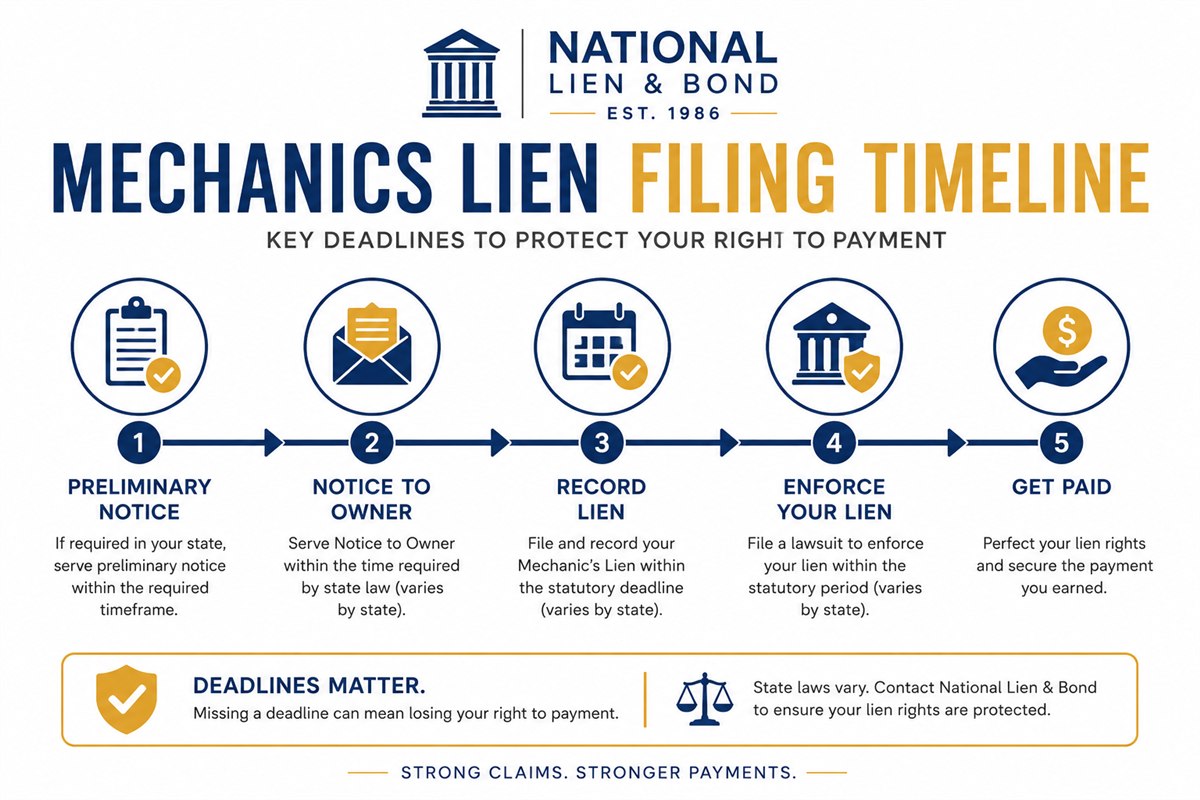
When and how to file a mechanics lien can be tricky, which is why help from a mechanics lien specialist is often required. The main difficulty with lien laws is they vary greatly from state to state and each state has its own reasons for being complicated. This article focuses on California's mechanics lien laws and how calculating notice and filing deadlines is the primary complication to successfully filing a lien.
the 20-day window
The first critical deadline you must meet to file an enforceable mechanics lien in California is the 20-day window for serving your notice of right to file lien. This notice must be served 20 days from when you begin providing labor or materials. The notice must be served on the property owner, general contractor, and, if the cost of the construction project is financed, the construction lender. If you fail to serve this notice within 20 days of first providing labor or materials, you can still serve the notice but any goods or services you provided more than 20 days prior to serving the notice cannot be the basis for filing a mechanics lien. If you fail to file the notice of right to file lien at all, you will be barred from filing an enforceable lien.
Waiting on money for a job?
Tell us what happened and National Lien & Bond will connect you with an attorney in your state. Free consultation, no obligation.
Determining when the deadline begins
The next and more complicated deadline is your deadline to file your mechanics lien. The difficulty construction contractors run into is determining when the deadline begins. California law states the period for filing a lien begins upon "completion" of work. It defines completion as occurring when, 1) work on the project is actually complete, 2) labor stops and the owner occupies or uses the premises, 3) labor stops continuously for 60 days, or 4) labor stops continuously for 30 days and a notice of completion or cessation is filed. Despite the definition, it's still unclear to many contractors when "completion" occurs.
when DOES completion occur?
The first listed instance of completion is upon "actual completion of the work". California law does not define "actual completion" so this fails to clarify when completion occurs. For example, if all final invoices are paid but small punch list items or warranty work still needs completion, is the work actually complete? California law left this question open for courts to answer.
Items 2 through 4 all require labor to stop before work is determined to be complete. Supply of materials are not addressed so it's possible material suppliers will continue to supply the project without knowing the project is technically complete and the period for filing a lien is running out. There's also the confusion of how the law applies to construction projects which are separated into phases. If all labor on phase one of a large project is finished and you will not perform any work on any other phases, does completion of the first phase start the lien filing clock running or do you get to wait until the entire project is completed, potentially several years later? Again, California legislators seem to have left this for the courts to decide.
Once completion IS FINAL
Once completion occurs, you have 90 days to file your mechanics lien or 60 days if the owner or general contractor filed a Notice of Completion or Cessation of work. While seemingly simple, it's still be unclear which period applies because there is no way to assure you will know whether a notice of completion was filed or not. California law requires the recording clerk to send notice that a completion notice is filed to contractors and suppliers who record their preliminary notices. However, preliminary notices are rarely filed because it's not necessary for filing a lien. Also, there is no incentive for the recording clerk to send this notice because there is no penalty if the clerk refuses to comply. Poorly drafted lien laws like these in California are why construction contractors and material suppliers need all the help they can get to protect their right to file mechanics liens in any state.
Waiting on money for a job?
Tell us what happened and National Lien & Bond will connect you with an attorney in your state. Free consultation, no obligation.
Related Articles
Filing a Lien to get paid for your work
A mechanics lien is a recorded claim against the property where you worked, giving you the right to have it sold to satisfy what you are owed. This overview covers the three core requirements every state shares: proper notice, accurate information, and meeting deadlines.
Read Article
What is a Notice of Commencement?
A notice of commencement formally sets the start date of a project and is filed by the owner or prime contractor. This guide explains where it is required or optional, how it affects lien deadlines, and what subcontractors need to know.
Read Article
Lien Law Review For the Top 6 Construction Boom States
A state-by-state review of mechanics lien rules in six high-growth construction markets: New York, Nevada, California, Texas, Florida, and Arizona. Covers licensing, preliminary notice, and filing deadline differences in each.
Read Article