Subcontractor Rights on Federal Construction Projects
A "Public Contract" is a project for a government or governmental entity. This could be a part of the Federal or national government, like a job with the Army Corps of Engineers, the Department of Defense or the Department of Agriculture. It could also be a part of a state, tribal, or local government, like a school district, a county hospital, a tribal town hall, a state prison or any number of other projects where some part of the government is the entity hiring the general contractor and directing or paying for the job.
In this article, we are going to focus on some of the rights and laws states have put in place for state and local projects. For more information on your rights in a Federal contract, see this article.
What is the difference between a Lien and a Bond claim?
On a government construction project, rather than filing a lien, you file a bond claim.
The government is not a risk- taking entity, they don't want there to be any chance that they pay the general contractor- but you never get paid and take them to court. So, they have the general contractor take out a contract or construction bond. The bond provides assurance to the project owner that the contractor will perform according to the terms of the contract. For bigger projects, these bonds come in two parts - one to protect against overall job incompletion and another to protect against nonpayment of materials from suppliers and labor from subcontractors.
The second part is where you, as the sub-contractor, can make your claim. There are multiple parties involved in a government construction project bond -the investor/project owners, the general contractor, the other parties building and contributing the project, and the surety company that backs the bond. When you make a claim, you make it against the general contractor's bond- but you make it through the surety company. It is their responsibility to make sure you get paid- and prevent the government from having any liability.
Waiting on money for a job?
Tell us what happened and National Lien & Bond will connect you with an attorney in your state. Free consultation, no obligation.
What are your rights on a public project?
Quite simply, the same as on a private project. You have the right to be paid for your work or supplies, in a timely manner, per the terms of the contract. Many states have prompt pay laws in addition to bond laws to protect subcontractors.
How do you protect your rights on a public project?
- Get a copy of the bond
Better safe than sorry- although not required, having a copy of the bond in your hands will help you be confident that you know how to get paid if payment doesn't come as expected. For public projects, the bond will be available at a governmental office, and shouldn't cost you anything to obtain. In some states it will be posted right on site and you can make a copy or take a photo there.
- File Preliminary Notice if it is required in your state
Some states require a preliminary notice in all public projects, these include: Arizona, California, Florida, Georgia, Iowa, Massachusetts, Michigan, Montana, Nevada, New Jersey, North Carolina, Ohio, Texas, Washington, Wisconsin and Wyoming. It may also be required in other states depending on the type of project (for instance a public-private project in states where notice is required for private entities). It is always best practice to file a preliminary notice as a matter of course, whether it is required in your state or not.
- File a Bond Claim within Deadlines
Each state has its own requirements, some will require you send a notice to the governmental entity in charge of the project before filing a claim, others only require the claim to be filed. The process to file a claim should be on the bond itself. But the most important piece is the deadlines, you must properly make your claim in the time allowed, in some states as little as 15 days after the completion of your part of the work.
- Provide Bonding/Surety Company with Documentation- and keep in contact until your bond is paid
Generally, once you file a bond with the bonding/surety company, they will reach out for a copy of the contract, a sworn statement that you have completed the work and backup documentation to show the work is complete. Responding quickly and with exactly what they ask for is important to keep everything moving and getting you paid quickly.
- If the Bonding Company doesn't pay in a timely manner- file an enforcement action
If the bond company doesn't pay right away, and your claim is either denied or delayed unreasonably, you can file a lawsuit against the surety to enforce your bond claim. You may also be able to enforce the prompt payment laws, and earn interest on the delayed payment.
Because the government construction project bond enforcement laws and how they're applied vary by state, and sometimes by project type, you want to be sure you're familiar with the law that applies to the project and area you're working. If you find the regulations confusing, be sure to reach out to someone who can help.
The attorneys at National Lien & Bond have experience in all 50 states and can help you make sure you're getting paid in a prompt and proper fashion and that you are properly paying your subcontractors and suppliers.
Waiting on money for a job?
Tell us what happened and National Lien & Bond will connect you with an attorney in your state. Free consultation, no obligation.
Related Articles
Is a Subcontractor Required to Send a Preliminary Notice on a Commercial Project in Montana?
Usually no. Montana exempts improvements that are partly or wholly commercial in character from the notice of right to claim lien. Here is what the exception covers, what JTL Group decided, and what a subcontractor still has to do to keep the lien alive.
Read Article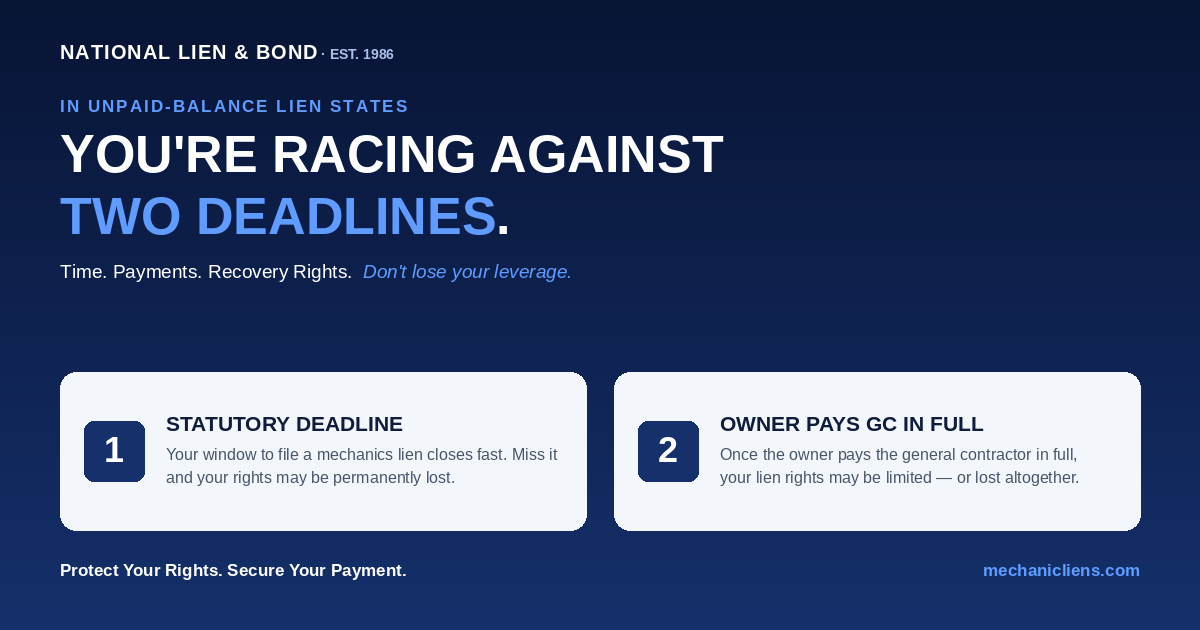
Unpaid-Balance Lien States: Two Deadlines to Track
In an unpaid-balance lien state, the calendar deadline to record your lien is only half the race. The hidden second deadline is the moment the owner finishes paying the general contractor - because that payment can shrink or erase the fund your lien attaches to. This guide explains both deadlines, why subcontractors and suppliers lose money even when they file 'on time,' and the notice-and-timing strategy that protects your leverage.
Read Article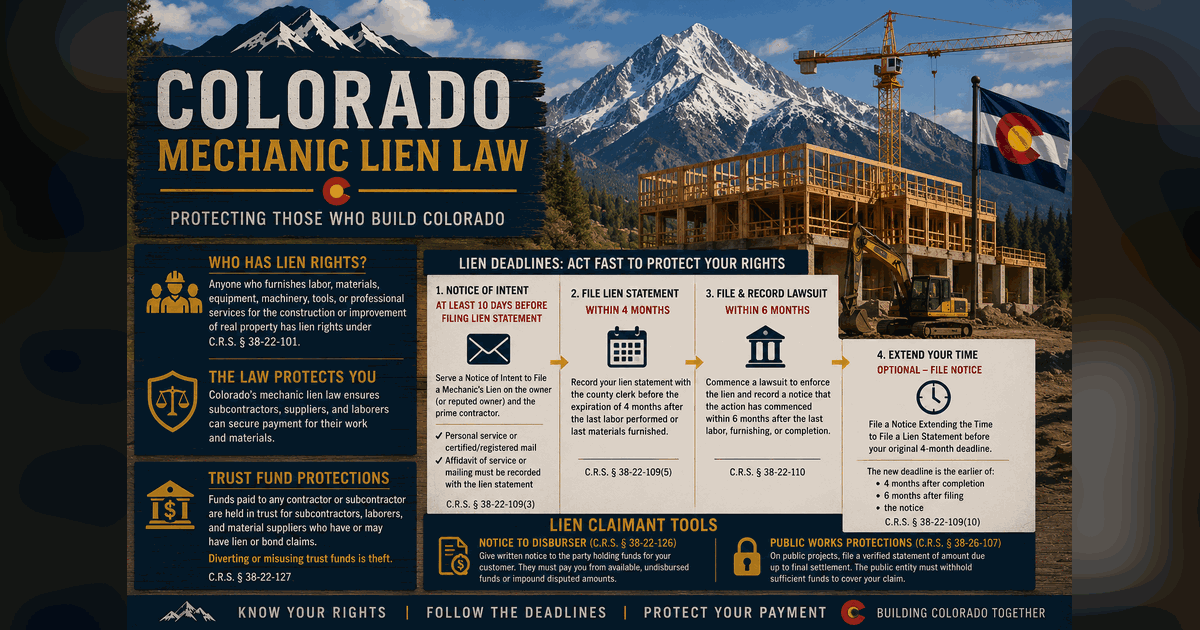
Colorado Subcontractor Lien Deadlines
Colorado subcontractors and suppliers usually protect payment rights by serving a Notice of Intent, recording a lien within 4 months, and filing suit within 6 months. Here is how the deadlines work, what commonly goes wrong, and how public-works bond claims differ.
Read Article