
A Primer on Stop Notice and Payment Bond Claims
In this pandemic time, many industries have to face the recession time. In this way, the construction and property building industry has got a major impact on Covid-19 across the world. In the United States, you will find a huge decrease in the real estate and construction domain during to pandemic. For instance, the public construction works in California. If you are planning to invest in public construction properties in California, you need to be alert, as the construction industry in the state is going down. But, the number of payment bond claim cases on public construction projects is increasing in California. If you have invested in public construction projects in the state, you might have to face lien issues on public properties due to higher prices.
Also read for YOUR GUIDE TO THE MILLER ACT VS. THE LITTLE MILLER ACT
Now, the good news is that the cases of payment bond claims on public constructions in California are decreasing and things are getting on track. Hence, it is necessary for investors to protect their investments for public constructions projects in California through legal ways. For betterment, you can take service of professional public construction works attorneys in California. The lawyers will help you know how to apply for Stop Notice on state public construction works in the state. Also, you can apply for notice for the claim that includes a lien on the fees held by the public construction contractor. Besides, the attorney will help you how to take action against payment bond claims and get things in your favor through legal steps. Before you go to apply for the payment bond notice or claim, you should know:
What is Payment Bond Claim and Payment Bond Notice in California
Payment Bond Claim
A payment bond claim is a surety or guaranty given for a contractor's responsibility to pay its subs and suppliers in advance.
Payment Bond Notice
A payment bond notice signifies that a surety bond needs to send to the contractor to guarantee that it will pay fees to subcontractors, laborers, and material suppliers on time. If you are an unpaid contractor or supplier, you are eligible to apply for Stop Notice on bond for a public construction project in California.
Here are two important remedies that you need to know first before filing for Stop Notice and Payment Bond Claims on public construction projects in California:
1. Stop Notice Remedy
When you apply for Stop Notice, you need to consider the following things:
- The contractor who is unpaid for its services or material supplying is applicable for filing Stop Notice for payment bond.
- Before filing for stop notice in California state construction projects, you need to send a 20-day preliminary notice first. After that, you can send a proper Stop Notice or certified mail to the public construction authority in the state.
- You should serve the Stop Notice for California public works to the director of the construction department in the state. The Stop Notice should issue to the authorized controller, commissioner, or public officer.
- You need to ensure that Stop Notice has prepared well and in the right order to mention details of debts and payments to claim for material supply, labourers' payment, and more.
2. Payment Bond Claims Remedy
For applying payment bond claims in California, you should remember the points as follows:
- It is not necessary to file for a Stop Notice Claim on Payment Bond. The contractor is not supposed to file for any improper or authorized bond on the project. Thus, there is no need to raise this step at the initial stage.
- When you find it legal to apply for a claim on a payment bond, you need to check some conditions such as: The pretender has not received the amount yet. Make sure, the applicant is eligible to pursue a claim process.
- You need to ensure that all claim details should have mentioned right in notice too.
- The payment bond claim should settle by the legal authority in the state.
Thus, you need to qualify all the terms and conditions to file for Payment Stop Notice and Payment Bond Claim on public construction projects in California. For legal help, you can contact professional public construction attorneys in the state.
Related Articles
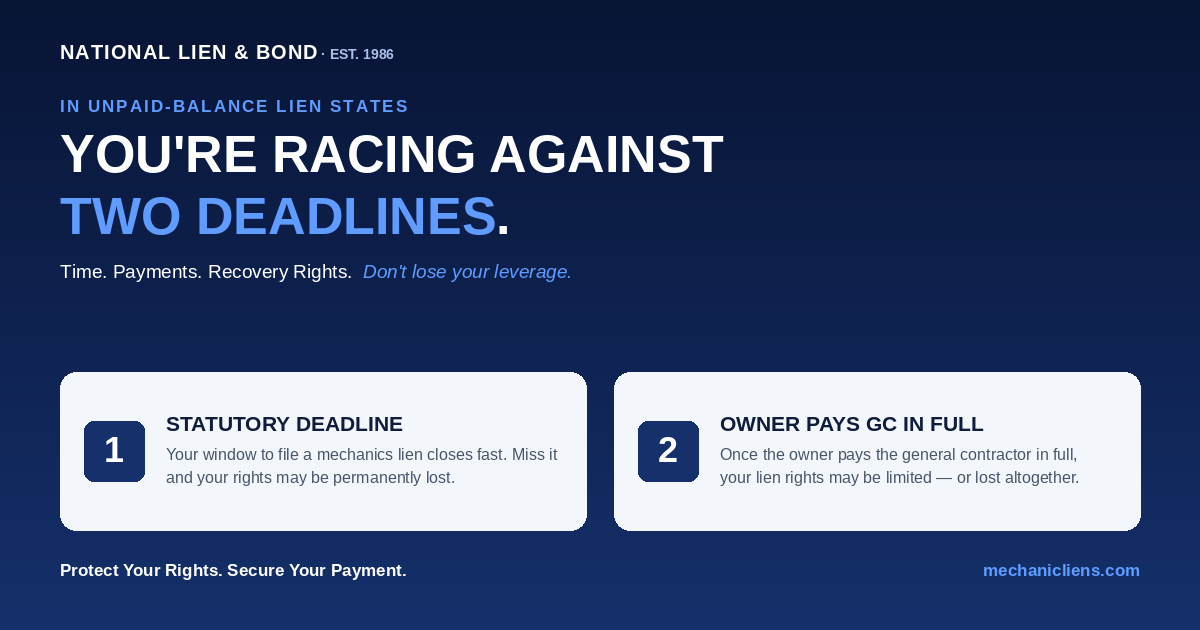
Unpaid-Balance Lien States: Why You're Racing Against Two Deadlines, Not One
In an unpaid-balance lien state, the calendar deadline to record your lien is only half the race. The hidden second deadline is the moment the owner finishes paying the general contractor - because that payment can shrink or erase the fund your lien attaches to. This guide explains both deadlines, why subcontractors and suppliers lose money even when they file 'on time,' and the notice-and-timing strategy that protects your leverage.
Read Article
Connecticut Mechanics Lien Law: Notices, Deadlines, Lien Rights, and Contractor Registration
Connecticut treats original contractors and lower-tier claimants differently. This guide covers the lower-tier notice of intent, the 90-day certificate recording deadline, the 30-day owner-service requirement, the one-year foreclosure-and-lis-pendens deadline, the lienable-fund limit on subcontractor liens, who can claim, and how Home Improvement Act and New Home Construction registration affect enforcement.
Read Article
Delaware Mechanics Lien Law: Statement of Claim, Deadlines, Lien Rights, and Contractor Registration
Delaware enforces mechanics liens through a strictly construed statement of claim filed in Superior Court. This guide covers the 180-day and 120-day filing deadlines, the prior-written-consent rule for tenant work, the statement-of-claim pleading elements, the $25 threshold, who can claim, and Delaware contractor registration and business licensing.
Read Article