
Construction Trust Fund Statutes: When Unpaid Project Funds Become Personal Liability
When a general contractor or subcontractor stops paying, the first question is usually whether the company can pay. When the company is insolvent, the next question is more important: where did the project money go?
A number of states treat money paid for a construction project as a trust fund for the benefit of the subcontractors, laborers and suppliers who built it. A contractor may breach a statutory trust by using protected project funds for purposes the governing statute does not permit. Whether overhead, loan payments or distributions constitute a violation depends on the applicable statute, the purpose of the expenditure and any available defense. In some states, the individuals who controlled the money can be held personally liable, and misuse can be a crime.
This article explains how trust fund statutes work in seven states and where their limits are. An unpaid invoice is not, by itself, a trust fund violation. The statutes reach the misuse of protected funds.
How Construction Trust Fund Statutes Work
The statutes differ, but most share four elements:
- A trust fund. Payments made under a construction contract for a specific project.
- A trustee. The contractor or subcontractor that receives the payments, and in some states the individuals who receive or control them.
- Beneficiaries. The subcontractors, laborers and suppliers who furnished labor or materials to that project, and in some states others.
- Misapplication. Using trust funds for a nontrust purpose before the beneficiaries are paid.
The value of these statutes is that they can reach past an insolvent company to the people who decided where the money went. They also operate independently of lien rights in some states, which matters when a lien deadline has already passed.
Texas: Property Code Chapter 162
Trust funds. Construction payments made to a contractor or subcontractor, or to its officer, director or agent, under a contract to improve specific Texas real property are trust funds. Qualifying improvement loan proceeds secured by a lien on the property are also covered. A contractor's fee is excluded only if the owner and contractor entered into the required written contract before construction began, the contract provides for payment of construction costs and a specified reasonable fee, and the fee has been earned and paid or disbursed as the statute requires. (Tex. Prop. Code § 162.001.)
Trustees. A contractor, subcontractor or owner, or an officer, director or agent of one, is a trustee if that person receives trust funds or has control or direction of them. A job title alone does not establish personal liability for misapplication. (Tex. Prop. Code § 162.002.)
Beneficiaries and assignments. Artisans, laborers, mechanics, contractors, subcontractors and material suppliers who furnish qualifying labor or materials are beneficiaries of trust funds connected with the improvement. A property owner is a beneficiary of covered trust funds in connection with a residential construction contract. (Tex. Prop. Code § 162.003.) Effective September 1, 2025, a beneficiary's qualified assignee is also a beneficiary, but an assignment of an interest in unpaid trust funds cannot be enforced unless it is in writing, is made no earlier than the date the assignee has paid the beneficiary in good funds for the assignment, and is not part of the beneficiary's construction contract. The assignee must be a beneficiary, trustee or property owner under the related contract, and written notice must be given to the property owner and contractor no later than the seventh day after the assignment. (Tex. Prop. Code § 162.0031.)
Misapplication. A trustee misapplies trust funds by intentionally, knowingly or with intent to defraud retaining, using or diverting them without first fully paying current or past-due obligations to the beneficiaries. Commingling does not defeat the trust. The statute provides affirmative defenses for qualifying actual construction expenses; retention after notice to a requesting beneficiary based on a reasonable belief that the beneficiary is not entitled to the funds; and retention authorized or required by Chapter 53. It also provides a defense if the beneficiaries receive all trust funds to which they are entitled within 30 days after the trustee receives specified written notice of a criminal complaint or pending criminal investigation. (Tex. Prop. Code § 162.031.)
Criminal penalties. Misapplying $500 or more is a Class A misdemeanor. Misapplying $500 or more with intent to defraud is a third-degree felony. The dollar threshold is the same; intent to defraud is the difference. (Tex. Prop. Code § 162.032.)
Civil personal liability. Texas courts allow civil recovery under Chapter 162. In Lively v. Carpet Services, Inc., 904 S.W.2d 868 (Tex. App. Houston [1st Dist.] 1995), the court held that an officer who controls trust funds can be personally liable without piercing the corporate veil, and that civil recovery does not require proof of intent to defraud. The court reversed summary judgment and remanded because the officer's affidavit concerning actual construction expenses and related office overhead raised a fact issue on the statutory expense defense. The majority rejected the argument that the defense required tracing each project's receipts exclusively to that project's expenses, and it did not finally decide whether the officer had established the defense. See our Texas lien law guide.
Michigan: Builders Trust Fund Act
For private construction projects, building contract funds paid to a contractor or subcontractor are held in trust for the person making the payment, contractors, laborers, subcontractors and material suppliers. An owner who makes the covered payment is therefore a statutory beneficiary. The receiving contractor or subcontractor is the trustee. (MCL 570.151.)
A contractor or subcontractor that, with intent to defraud, retains or uses the funds for any purpose other than first paying the laborers, subcontractors and suppliers on that improvement commits a felony, punishable by a fine of $100 to $5,000, imprisonment of six months to three years, or both. (MCL 570.152.) Using the funds before paying amounts due or to become due to the protected parties is evidence of intent to defraud. (MCL 570.153.)
Michigan courts recognize a civil cause of action under the Act for private construction contracts, even though the statute does not expressly provide one. A claimant need not prove a fraudulent misrepresentation; it must show receipt of project funds and their use for other purposes before the protected parties were paid. The civil claim is governed by the six-year residual limitations period, generally running from the actionable receipt and appropriation of the protected funds. DiPonio Construction Co. v. Rosati Masonry Co., 246 Mich. App. 43, 631 N.W.2d 59 (2001). See our Michigan lien law guide.
Waiting on money for a job?
Tell us what happened and National Lien & Bond will connect you with an attorney in your state. Free consultation, no obligation.
New York: Lien Law Article 3-A
New York has the most developed construction trust statute in the country.
- The trust. Section 70 identifies the receipts and rights to payment that constitute trust assets. For owners, coverage depends on the statutory source and conditions of the funds. An owner holds a separate trust for each improvement. A contractor or subcontractor holds a separate trust for each contract or subcontract, and each trust begins when its first asset comes into existence. (N.Y. Lien Law § 70.)
- Beneficiaries. Subcontractors, laborers, suppliers and others with trust claims are beneficiaries. A qualifying beneficiary need not have filed, or even had the right to file, a notice of lien. (N.Y. Lien Law § 71.)
- Diversion. A transaction applying trust assets to a nontrust purpose before all trust claims have been paid or discharged is a diversion. If the diversion results from the trustee's voluntary act or consent, it is also a breach of trust. (N.Y. Lien Law § 72.)
- Enforcement. A beneficiary's action must be brought as a representative action on behalf of all beneficiaries, following class action procedure as nearly as possible, although the court may waive the numerosity requirement. Remedies include an accounting, recovery of diverted funds, injunctions and damages. The action must be commenced no later than one year after completion of the improvement. For a subcontractor or material supplier, the deadline is the later of that date or one year after final payment under the claimant's contract became due. (N.Y. Lien Law § 77.)
- Larceny. Section 79-a imposes larceny liability on a trustee, officer, director or agent who applies, or consents to applying, covered trust funds to a nontrust purpose when the statutory conditions are satisfied. For an owner trustee, the provision addresses such application before all trust claims are paid. For a contractor or subcontractor trustee, it additionally requires failure to pay a trust claim within 31 days after it becomes due. A good-faith dispute avoids liability on that basis if the claim is paid within 31 days after final determination of the dispute, and the statute protects qualifying reimbursement of advances actually used for trust purposes. (N.Y. Lien Law § 79-a.)
See our New York lien law guide.
Illinois: The Lien Waiver Trust
Illinois's provision is narrower. When an owner, contractor, subcontractor or supplier of any tier requests or requires a lien waiver in exchange for payment or a promise of payment, the money it receives as a result of that waiver is held in trust for the party that furnished the work or is otherwise entitled to the payment. A separate account is not required, and commingling alone is not a violation. A covered party that knowingly retains or uses those trust funds for a purpose other than paying the persons for whom they are held is liable to a person who successfully enforces the section for the damages that person sustained. (770 ILCS 60/21.02.)
The practical lesson: an Illinois subcontractor that signs a lien waiver to release the general contractor's draw, and is then not paid, may have a trust claim in addition to its lien and contract claims. See our guide to lien waivers in Illinois.
Colorado: Trust Funds and Civil Theft
Qualifying funds disbursed to a contractor or subcontractor under a building, construction or remodeling contract, or on a construction project, are held in trust for the protected subcontractors, laborers and material suppliers identified in the statute, including qualifying claimants against a principal and surety. A claimant need not have perfected a mechanics lien or remain able to perfect one. The statute contains exceptions for good-faith disputes and setoffs, for a performance or payment bond furnished by the contractor or subcontractor, and for a written release executed by the property owner. It requires separate project accounting records but not a separate bank account. (C.R.S. § 38-22-127(1)-(4).)
A violation of the trust requirements may constitute theft under § 38-22-127(5), but liability requires proof of the elements of theft under § 18-4-401, including the required mental state. A trust violation alone does not establish theft. When theft is proven, the civil theft statute allows recovery of three times actual damages or $200, whichever is greater, plus costs and reasonable attorney's fees. (C.R.S. § 18-4-405.)
Two Colorado Supreme Court decisions frame the statute. In re Regan, 151 P.3d 1281 (Colo. 2007), held that a claimant does not need a perfected lien, or a lien it could still perfect, to pursue the trust remedy. Yale v. AC Excavating, Inc., 2013 CO 10, 295 P.3d 470, held that a member-manager's voluntary survival loans were not trust funds because, under the circumstances, they capitalized the business rather than funded a construction project. The court considered the totality of the circumstances, including the purpose and conditions of the disbursements. Because those funds were not trust assets, the theft claim based on their alleged diversion failed. See our Colorado lien law guide.
New Jersey: Public Improvement Payments
Money paid by a New Jersey public entity to a contractor under a public improvement contract is a trust fund in the contractor's hands until all labor, material and other charges connected with the work are paid. (N.J.S.A. 2A:44-148.) This provision applies to public projects; it is not a general private-construction trust statute. See our New Jersey lien law guide.
Washington: Public Works Retainage
Washington's provision is a public works retainage system, not a trust over payments a contractor receives. On covered public improvement contracts, the public body must reserve retainage of up to 5 percent as a trust fund for the protection of persons who furnish labor and materials, and for specified state tax obligations. Persons performing labor or furnishing supplies toward completion of the contract have a lien on the retained funds. They must give notice within 45 days after completion of the contract work, in the manner prescribed by RCW 39.08.030. To preserve enforcement against the retainage, a claimant generally must also commence a foreclosure action within four months after filing the claim. Federally funded transportation projects and contracts where a bond replaces retainage are treated differently. (RCW 60.28.011, 60.28.030.) The former section, RCW 60.28.010, was repealed in 2009. See our Washington lien law guide.
Quick Reference
| State | What is held in trust | Personal or enhanced exposure |
|---|---|---|
| Texas | Construction payments and secured loan proceeds | Trustee liability for persons who receive or control funds; misdemeanor at $500, felony with intent to defraud |
| Michigan | Building contract payments on private projects | Civil claim; felony with intent to defraud |
| New York | Statutory trust assets of owners, contractors and subcontractors | Representative action; larceny when § 79-a conditions are met |
| Illinois | Funds received in exchange for a lien waiver | Damages for knowing retention or misuse |
| Colorado | Qualifying construction disbursements | Civil theft remedies if theft elements are proven |
| New Jersey | Public improvement payments | Trust over public contract funds |
| Washington | Public works retainage | Lien on retained funds |
Trust Fund Claims in Bankruptcy
Trust fund statutes become especially important when a contractor's owner files for personal bankruptcy. A debt for "fraud or defalcation while acting in a fiduciary capacity" may be excepted from an individual debtor's discharge. (11 U.S.C. § 523(a)(4).) The creditor generally must file a timely complaint in the bankruptcy court to obtain that determination. (11 U.S.C. § 523(c)(1).)
Two central issues are whether the individual debtor acted in a qualifying fiduciary capacity and whether the debtor committed fraud or defalcation in that capacity. The creditor must also establish a debt owed by that individual and satisfy the applicable procedural requirements. Ownership of the contracting company alone does not establish personal liability. Whether the debtor acted in a fiduciary capacity is a question of federal bankruptcy law; a state statute that labels funds a "trust" is relevant but not conclusive.
Defalcation requires knowledge that the fiduciary conduct is improper or gross recklessness concerning its impropriety. Gross recklessness includes consciously disregarding, or being willfully blind to, a substantial and unjustifiable risk that the conduct violates a fiduciary duty, where that disregard represents a gross deviation from lawful conduct in the circumstances. Negligence or an innocent mistake is not enough. Bullock v. BankChampaign, N.A., 569 U.S. 267 (2013). See our guide to protecting your claim in a contractor bankruptcy.
How to Use a Trust Fund Claim
- Preserve your lien and bond rights first. A trust claim is an additional remedy, not a substitute. Serve notices and file liens on time.
- Document the project payments. Pay applications, owner payment records, joint checks and lien waivers show what the contractor received for your work.
- Identify who received or controlled the money. In Texas and New York, the individuals who directed the funds can be personally liable when the statutory conditions are met.
- Use the statute in your demand. A demand letter can identify the trust statute and the individuals' potential exposure. See our guide to demand letters for bad debt.
- Act quickly in bankruptcy. For a claim under § 523(a)(4), the creditor generally must file an adversary complaint within 60 days after the first date set for the § 341(a) meeting of creditors. A motion to extend that deadline must be filed before it expires. Different rules may apply to certain debts that were not properly scheduled and to complaints outside § 523(c). (Fed. R. Bankr. P. 4007(c).)
- Check coverage and defenses. Check whether the funds and claimant fall within the statute and whether a statutory exception or defense applies. Qualifying expense payments and good-faith disputes may matter under particular statutes, but they are not universal defenses.
The Bottom Line
A contractor that receives your project money and spends it elsewhere may not be able to hide behind its corporate form. Where a trust fund statute applies and its conditions are met, the people who controlled the money may answer for it personally. If a contractor has collected for your work and not paid you, contact us to have an attorney in our network review whether a trust fund claim is available, and see our collections services.
This article provides general information and is not legal advice. Trust fund statutes have specific coverage rules, defenses and limitations periods, and criminal provisions are enforced by prosecutors, not private parties. Confirm the current statute and consult counsel before asserting a trust fund claim.
Waiting on money for a job?
Tell us what happened and National Lien & Bond will connect you with an attorney in your state. Free consultation, no obligation.
Frequently Asked Questions
What is a construction trust fund statute?
A law that treats payments made for a specific construction project as held in trust for the subcontractors, laborers and suppliers on that project. Using the money for purposes the statute does not permit before they are paid can be a breach of trust, and in some states a crime.
Can a contractor's owner be personally liable for unpaid subcontractors?
In some states, yes, if the individual received or controlled trust funds and misapplied them. In Texas, Lively v. Carpet Services, Inc., 904 S.W.2d 868 (Tex. App. 1995), held that a controlling officer can be personally liable without piercing the corporate veil. Ownership of the company alone does not establish personal liability.
Is misapplying construction funds a crime in Texas?
Yes. Misapplying $500 or more in trust funds is a Class A misdemeanor, and doing so with intent to defraud is a third-degree felony. Tex. Prop. Code § 162.032.
Do I need a valid mechanics lien to bring a trust fund claim?
Not necessarily. In Colorado, In re Regan, 151 P.3d 1281 (Colo. 2007), held that a qualifying trust claimant need not have perfected a lien or remain able to perfect one. In New York, a qualifying beneficiary need not have filed, or even had the right to file, a notice of lien. Requirements vary by state.
Can a trust fund debt be discharged in bankruptcy?
A trust fund debt may remain enforceable after discharge. A debt for defalcation while acting in a fiduciary capacity may be nondischargeable under 11 U.S.C. § 523(a)(4) if the creditor proves a qualifying fiduciary relationship and the culpable state of mind described in Bullock v. BankChampaign, 569 U.S. 267 (2013), and files a timely complaint. See the bankruptcy deadline discussed above.
Is an unpaid invoice automatically a trust fund violation?
No. The statutes reach the misuse of protected project funds. A claim may fail because the funds are not protected by the statute or because an applicable exception or defense is established. Expense payments and good-faith disputes must be evaluated under the particular state statute.
Sources
- 1.Tex. Prop. Code §§ 162.001, 162.002, 162.003, 162.0031, 162.031, 162.032; Tex. S.B. 841, 89th Leg., R.S. (2025).
- 2.Lively v. Carpet Services, Inc., 904 S.W.2d 868 (Tex. App. Houston [1st Dist.] 1995).
- 3.MCL 570.151, 570.152, 570.153.
- 4.DiPonio Construction Co. v. Rosati Masonry Co., 246 Mich. App. 43, 631 N.W.2d 59 (2001).
- 5.N.Y. Lien Law §§ 70, 71, 72, 77, 79-a.
- 6.770 ILCS 60/21.02.
- 7.C.R.S. §§ 38-22-127, 18-4-401, 18-4-405.
- 8.In re Regan, 151 P.3d 1281 (Colo. 2007); Yale v. AC Excavating, Inc., 2013 CO 10, 295 P.3d 470.
- 9.N.J.S.A. 2A:44-148.
- 10.RCW 60.28.011, 60.28.030.
- 11.11 U.S.C. § 523(a)(4), (c)(1); Fed. R. Bankr. P. 4007(c); Bullock v. BankChampaign, N.A., 569 U.S. 267 (2013).
Related Articles
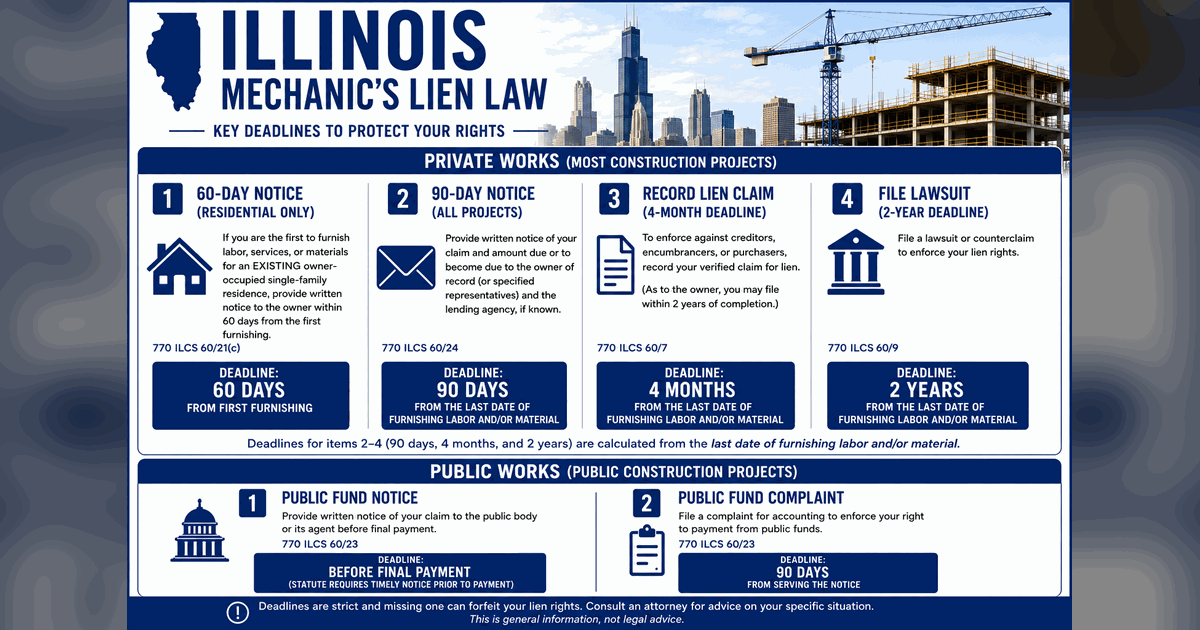
Illinois Subcontractor Lien Deadlines
Illinois subcontractors and suppliers protect payment rights by serving the 90-day notice, recording within 4 months to protect priority, and filing suit within 2 years. This guide explains the deadlines, residential traps, trust-fund issues, and public-works alternatives.
Read Article
Colorado Subcontractor Lien Deadlines
Colorado subcontractors and suppliers usually protect payment rights by serving a Notice of Intent, recording a lien within 4 months, and filing suit within 6 months. Here is how the deadlines work, what commonly goes wrong, and how public-works bond claims differ.
Read Article
When a General Contractor Goes Bankrupt, Can a Subcontractor File a Mechanic Lien?
A general contractor's bankruptcy filing can devastate unpaid subcontractors and suppliers. Here is what you need to do immediately to protect lien, bond, and preference positions.
Read Article