Using UCC Filings to Secure Contract Payments
UCC Article 9 financing statements are regularly used by companies that sell products to end users or resellers to help secure payments when credit terms are part of the sale. The financing statement is filed with the county where the purchaser does business and publicly secures the seller's lien against the buyer until the seller has been paid. Interestingly, it is also possible for both subcontractors and suppliers to construction projects to use the UCC to secure their payments in situations where, for whatever reason, mechanics' lien procedures aren't available.
How a "Lien Credit" Agreement Works
In many cases, your role in a project is too attenuated to allow you to take advantage of the mechanic's lien laws in the state where the project is located. Perhaps you're a sub-contractor to a sub-contractor or are supplying materials to one of the lower-tier subs and, as a result, are not in a position to be able to file a mechanics' lien against the property if you don't get paid. How can you secure your payment?
If your customer does enjoy mechanics' lien rights, you insert a clause into your contract that grants you a security interest in the customer's mechanics' lien rights that it has in connection with the project, equal in amount to the value of your contract with that customer. Then, you record that interest like any other UCC security interest. This "lien credit" clause provides you with a substantially higher level of security (and more leverage) than what you would have had without the clause - which would essentially just be the right to sue your customer if you don't get paid.
Waiting on money for a job?
Tell us what happened and National Lien & Bond will connect you with an attorney in your state. Free consultation, no obligation.
Emalfarb Law LLC Can Help You Negotiate Your Way to a More Secured Position
At Emalfarb Law LLC and National Lien & Bond, we've helped thousands of clients nationwide negotiate and enforce their construction project contracts. Our focus is helping you put yourself in a position to ensure you get paid for the work you do and the materials you supply to a project. We can also work with you to create internal systems that will help you stay on top of your receivables and make it easier to take swift and effective action in cases where payments start to lag. You can learn more about how we can help you help yourself collect what you're owed by checking out our webinar, "How to Get Paid Even When Your Mechanics Lien Rights Expire."
Call Emalfarb Law LLC and National Lien & Bond today at (800) 432-7799, or go online to set up a free consultation to learn more about how we can help you get paid.
Waiting on money for a job?
Tell us what happened and National Lien & Bond will connect you with an attorney in your state. Free consultation, no obligation.
Related Articles
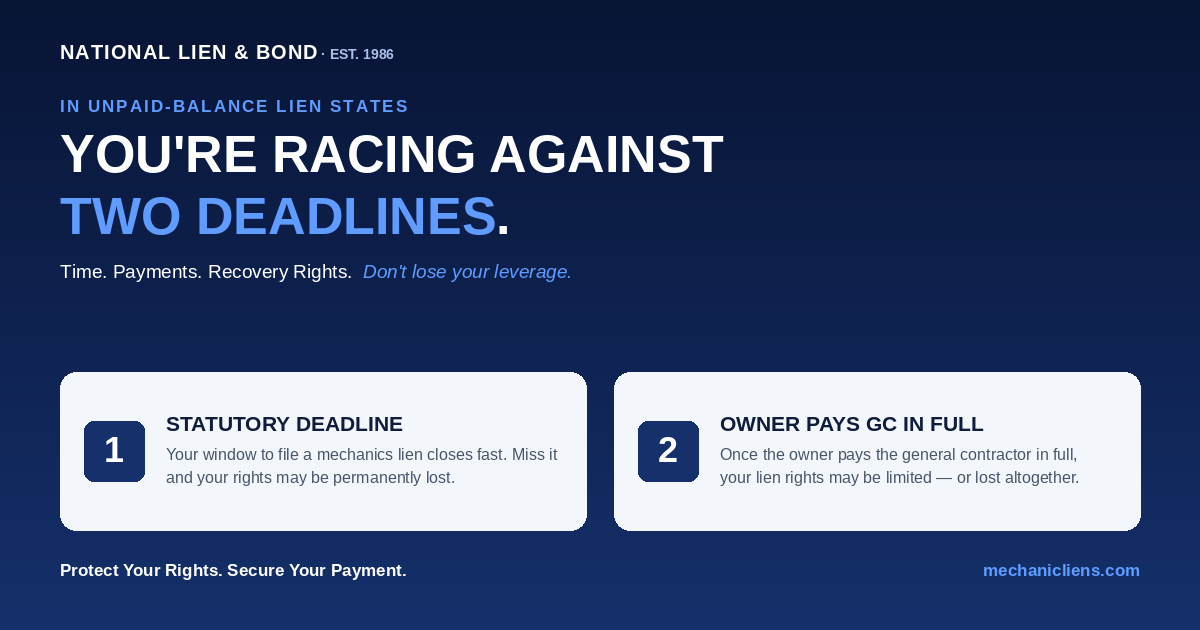
Unpaid-Balance Lien States: Two Deadlines to Track
In an unpaid-balance lien state, the calendar deadline to record your lien is only half the race. The hidden second deadline is the moment the owner finishes paying the general contractor - because that payment can shrink or erase the fund your lien attaches to. This guide explains both deadlines, why subcontractors and suppliers lose money even when they file 'on time,' and the notice-and-timing strategy that protects your leverage.
Read Article
Factoring Companies and Construction Receivables
Factoring can even out cash flow, but it rarely removes your collection risk, and factors secure their advances with a UCC filing against your invoices. This guide explains how factoring works and why you still need to protect your lien and bond rights.
Read Article
The Negotiation Equation - Your Key to Payment
Emalfarb Law's Negotiation Equation reduces payment leverage to a simple formula: Transaction plus Power equals Payment. This post explains each variable and how a strong contract combined with preserved legal rights puts you in a better position to collect.
Read Article