How to Overcome Key Challenges with Illinois Vendor Payment
To address the crisis that is currently the backlog of Illinois vendor payments due by the state, in October, Governor Rauner borrowed more than $6 billion to begin paying off those bills. This backlog initially totalled over $16 billion and certainly included payments owed to construction companies. As of December 2017, the state still owed over $9 billion, a number that seems daunting to anyone still awaiting payment for work performed.
As the Republican governor and the Democratic legislature fought over spending, contractors continued to work, racking up payments owed and accruing interest at the rate of 12 percent per year. By issuing a series of bonds, the Governor is transferring the debt from the contractors waiting for payments to willing lenders. The state estimates that, by June of 2018, these debts will be cut to $7.5 billion, half of what they were but hardly where contractors owed money would like them to be.
Waiting on money for a job?
Tell us what happened and National Lien & Bond will connect you with an attorney in your state. Free consultation, no obligation.
Illinois Vendor Payment
The Illinois Comptroller website offers vendors a chance to check on their payments and view non-confidential remittance information. They also show clearly how the state is doing paying the backlog of claims and how many are still outstanding. While they are working to increase transparency and payments, the huge backlog makes this problem difficult. Further, the state of Illinois has a reputation for being slow to pay bills and many contractors are less than enthused about relying on the government to solve the problem they created.
Illinois Vendor Assistance Program
The Vendor Assistance Program, LLC has sprung up to address the challenges of being paid by the state government in Illinois. This program will buy the invoices from contractors and then works to collect the amount owed and interest penalties due. This works for contractors who are getting paid for at least the bulk of the invoice (90 cents on the dollar) and for the company, who works to collect these invoices.
Other Options
Going long periods of time without being paid can be difficult for any business, but especially in the construction industry where there's a chain of payments that must be made. Knowing how long the state takes to pay its bills and still wanting to work for the government, it is wise, where possible, for contractors to ensure that their projects are bonded and payment from the bond company will be forthcoming. For businesses with the ability to wait until the state finally makes their payment, collecting the 12 percent interest penalty may soften the blow on the unpaid amount.
For help navigating the changing waters of Illinois' vendor payments and collections, you can reach out the the team at National Lien & Bond. Depending on your specific situation, we can recommend a solution to ensure your protect your right to payment, help you find a way to convert your invoice, or come to another arrangement that works for your unique situation. If you're interested in seeing what we can do to help you, contact us today to set up a free consultation where we discuss your specific problem and possible solutions.
Waiting on money for a job?
Tell us what happened and National Lien & Bond will connect you with an attorney in your state. Free consultation, no obligation.
Related Articles
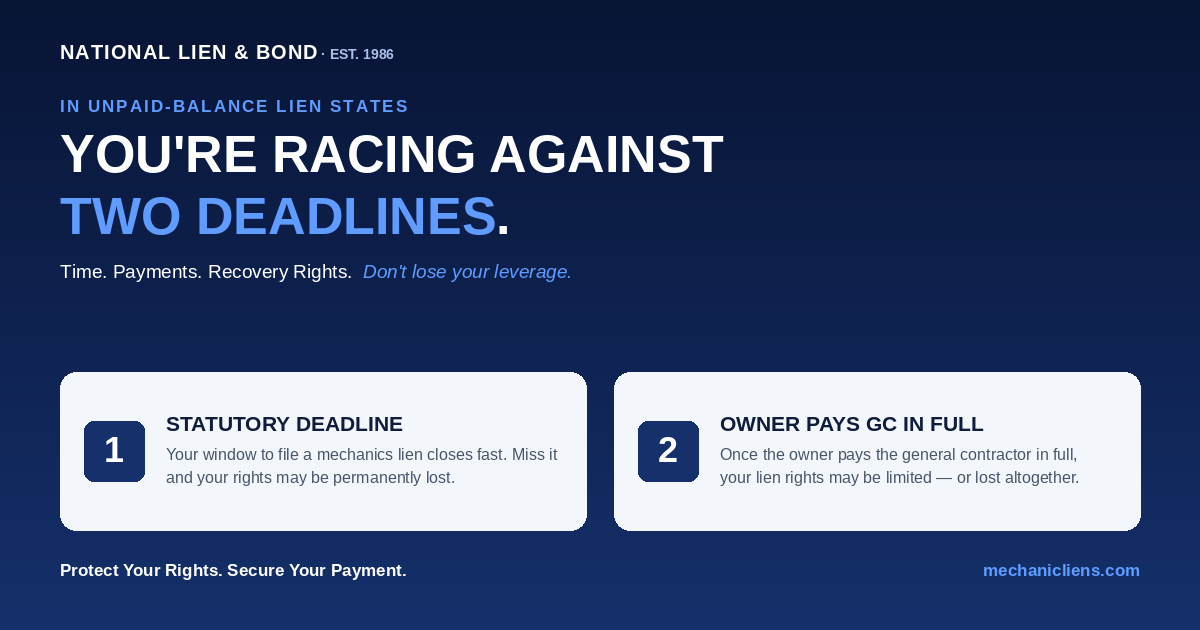
Unpaid-Balance Lien States: Two Deadlines to Track
In an unpaid-balance lien state, the calendar deadline to record your lien is only half the race. The hidden second deadline is the moment the owner finishes paying the general contractor - because that payment can shrink or erase the fund your lien attaches to. This guide explains both deadlines, why subcontractors and suppliers lose money even when they file 'on time,' and the notice-and-timing strategy that protects your leverage.
Read Article
Factoring Companies and Construction Receivables
Factoring can even out cash flow, but it rarely removes your collection risk, and factors secure their advances with a UCC filing against your invoices. This guide explains how factoring works and why you still need to protect your lien and bond rights.
Read Article
Using UCC Filings to Secure Contract Payments
When you are too far down the contracting chain to file a mechanics lien, a UCC Article 9 financing statement can still secure your payment. This post explains how a "lien credit" clause grants you a security interest in your customer's lien rights.
Read Article