Is My Job Bonded? Payment Bond Claims Explained
Did you know that in addition to state and federal jobs, most large commercial jobs have payment bond protection? In many cases enforcing payment bond claims is more effective than pursuing lien rights.
You typically will want to enforce both your lien rights and your bond rights.
What is the Difference between a Lien and a Bond?
A lien is a security interest in the title to property, taken out by those who have supplied labor or materials that improve the property but have not been paid.
A bond is 'insurance' that is put up/taken out in advance of the project to ensure that those who have supplied labor or materials to the project get paid.
How Do I Know if My Job is Bonded?
Ask. You can ask the general contractor to specify if the job is bonded, you can ask the local inspector's office for a copy of the bond, and you can look on site for a copy of the posted bond. If the project is bonded, it is in your best interest to get a copy of the bond, and to find out what, if any, preliminary notice is required for your work to be protected by the bond.
How Do Payment Bonds Get You Paid?
Waiting on money for a job?
Tell us what happened and National Lien & Bond will connect you with an attorney in your state. Free consultation, no obligation.
In a bond, the money is already 'there' - that is there is virtually no chance that there isn't a pot of money available to pay for the project- because the bond (which is essentially insurance) was put up to cover the project before it even started. In a lien, there is a chance you are making a lien against an entity that is insolvent- or doesn't have the money to pay.
When you make a claim, you make it against the general contractor's bond- but you make it through the surety company. It is their responsibility to make sure you get paid- and prevent the owner of the project from having any liability.
Why enforce both Lien and Bond rights?
In some cases (like public projects) a bond action may be your only choice. So making sure you enforce the bond is vital to making sure you get paid.
However, in cases of private projects that have been bonded- where both avenues are available- enforcing both, or at least making a non-paying general contractor or project owner aware that you are willing to go down both routes, may get you paid faster. In some states, only a lien action can take advantage of the prompt pay laws- which may mean interest if you weren't paid in a timely manner.
There are some projects where it may look like you have lien rights - but you don't. For example, since you can't make a lien against public land, a private project (owned by a private company), but built on public land might not be lien-able. In that case, enforcing the bond would be your only choice. And if you didn't enforce all your rights within the timelines, you might find out you can't file a lien after the time to file a bond have expired!
Because the bond enforcement laws and how they are applied vary by state, and sometimes by project type, you want to be sure you're familiar with the law that applies to the project and area you're working. If you find the regulations confusing, be sure to reach out to someone who can help.
The attorneys at National Lien & Bond have experience in all 50 states and can help you make sure you're getting paid in a prompt and proper fashion and that you are properly paying your subcontractors and suppliers.
This blog post was originally published in Dec. 21, 2016 and has since been updated
Waiting on money for a job?
Tell us what happened and National Lien & Bond will connect you with an attorney in your state. Free consultation, no obligation.
Related Articles
Unpaid-Balance Lien States: Two Deadlines to Track
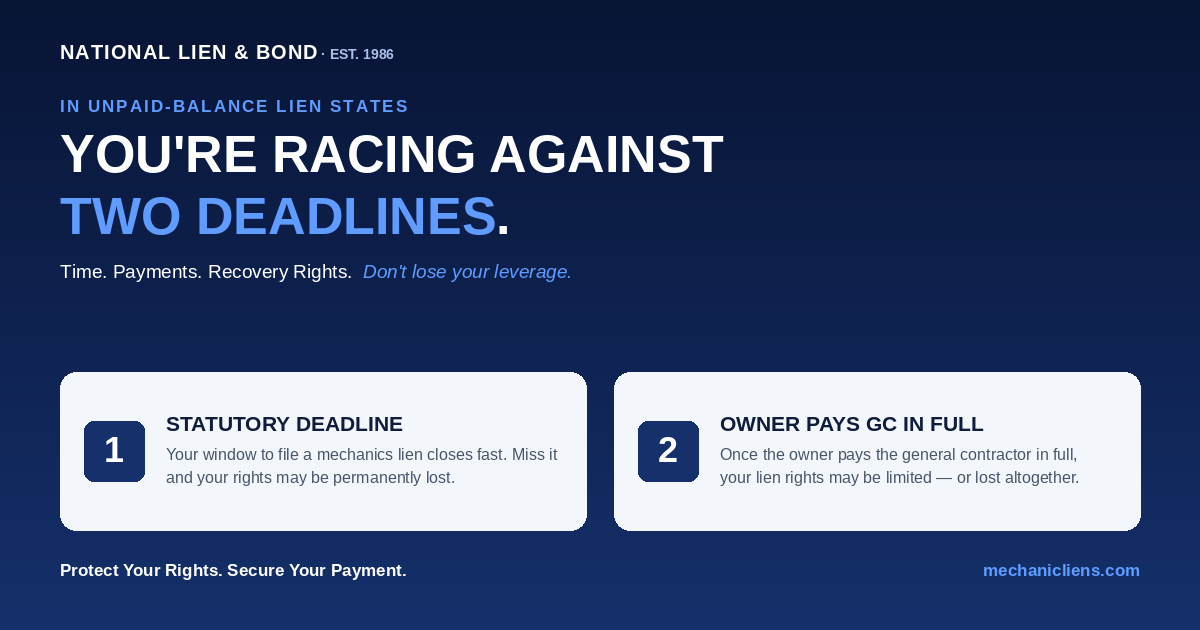
In an unpaid-balance lien state, the calendar deadline to record your lien is only half the race. The hidden second deadline is the moment the owner finishes paying the general contractor - because that payment can shrink or erase the fund your lien attaches to. This guide explains both deadlines, why subcontractors and suppliers lose money even when they file 'on time,' and the notice-and-timing strategy that protects your leverage.
Read Article
Factoring Companies and Construction Receivables
Factoring can even out cash flow, but it rarely removes your collection risk, and factors secure their advances with a UCC filing against your invoices. This guide explains how factoring works and why you still need to protect your lien and bond rights.
Read Article
Using UCC Filings to Secure Contract Payments
When you are too far down the contracting chain to file a mechanics lien, a UCC Article 9 financing statement can still secure your payment. This post explains how a "lien credit" clause grants you a security interest in your customer's lien rights.
Read Article